Twenty years has changed Venice, or maybe just changed us.
When I was last here I was 24 years young, adventurous and in love. I’d tuck in tightly behind Derek, my hand in his, and we’d move efficiently and quietly. I felt sexy and fearless then. But no longer a company of two we are now five, and no matter how hard we try we are still clunky. In this pack, I am “Mom.”
We happen to be here for record-breaking temperatures, and a sweltering and humid heat radiates off the bricks and stones. Our clothes stick to us. Twenty years ago I would have found it sultry and sensual, but today I carry four portable fans and five water bottles. I am the family pack horse, and there is nothing sexy about it.
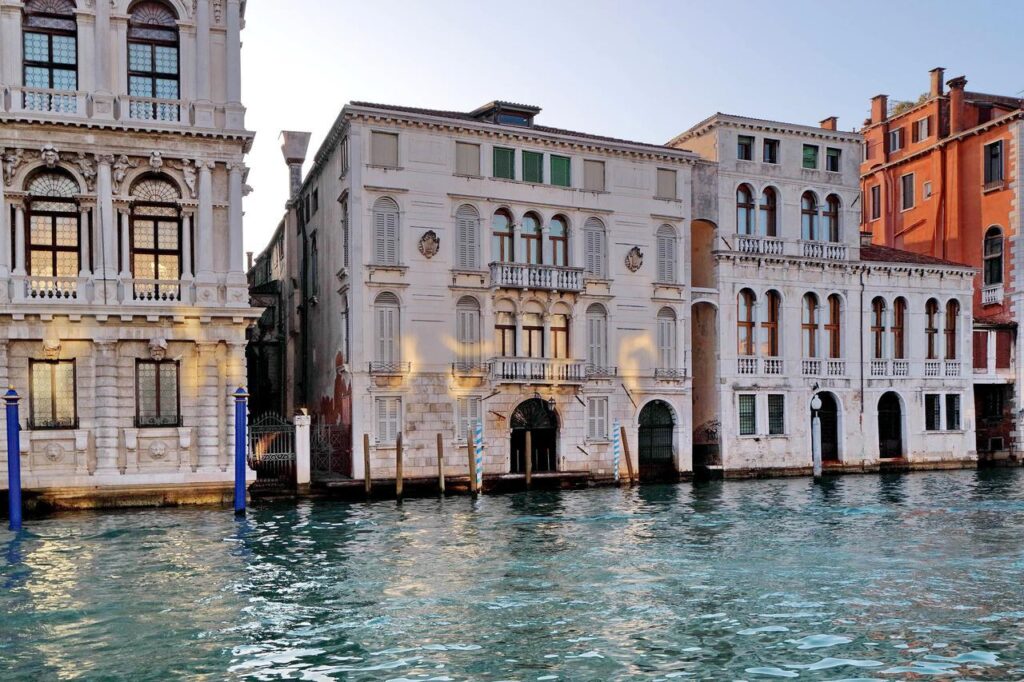
On the breeze along the Grand Canal (or entering from the Canale delle Fondamenta Nuove), it feels like the bay at home: the smell of warm saltwater and fish, the call of seagulls and the hum of motorboats, the lapping of waves against the docks.
But off the water in the tangle of streets we are clearly far from home. Bell towers periodically open their throats and sing ancient notes to one another across the sestieri, or six districts. In the shadow of stained, decrepit buildings, shopkeepers sell relics of an age long past: quills, marionettes, and paper mâché masks.
Here and there the maze of alleys opens up abruptly to a sun-bleached campo, or square, and our eyes blink to adjust. These neighborhood gathering spots range from small and secluded, to expansive with a church and several bars. No matter its size, each campo features a centuries-old wellhead of weathered stone. Once essential to daily life these rainwater cisterns are now ornamental—silent monuments to times gone by. Each one is different, and I find myself scouting for them.
My family forms a line down these narrow corridors: Derek leading the way, girls in step behind, then my son, with me at the back. Mitch looks at his feet as he walks, clearly playing “don’t step on a crack.” It’s too hard at this pace to try to tell him to look up—to look around—that there’s so much unusual stuff to see. But I learn that he has his own way of experiencing this city. His hunt is for gelato, for pigeons, and for pissotte, which he learned about on a tour.
Pissotte look like slanted seats; they are mortar slopes occupying the city’s dark corners. They are designed to prevent bandits from lying-in-wait and to keep drunkards from publicly urinating in the nook. Mitch points out every one he spies: pissotta! And every pigeon he sees: pizchón! (Which is not how you say pigeon in Italian, but he’s committed).
We reroute to avoid an anti-U.S. protest. The female shouting into the megaphone sounds hostile, and I find unsettling their red and black flags. Polizia cluster in their armored vests and berets, or bob nearby aboard waverunners in the canal. Americans aren’t the only tourists crowding the Rialto Bridge; languages surround us from every far-flung region of the globe. But as the activists’ shouts fade into the distance, I wonder at others’ experiences. We didn’t need a demonstration to know we aren’t warmly welcomed here, only tolerated. I don’t know how much of this is exacerbated by Bezos’ nuptials, I only know it used to be different.
Graffiti is everywhere, and the city feels dirty in a way I don’t remember before. Feathers and bird poop, smeared gelato, stickers publicly placed on bridges, stairs, lampposts. And so much litter—scattered about and overflowing from waste bins, tucked into windowsills, left on stoops—strangely all beneath the gaze of architectural angels and saints.
I don’t remember if twenty years ago I noticed the Eastern influence in this city: the millennia-old echoes of Constantinople in the Byzantine windows and mosaics, the geometric patterns and the art. But now I see it everywhere, and in my mind it sets an intriguing scene for the flag of Palestine I see draped here or there from upper windows, and the “Free Palestine” scribbled onto walls.
Our gondola silently creeps down quiet canals. Hundreds of silverfish run over the stones to escape our approaching boat. Mullet gape their mouths near stairs that descend into inky water. Rain clouds blanket the sky—now a stormy blue as dusk settles over the Grand Canal. And all along the banks, pali stand at attention like faithful soldiers. These are my other favorite thing to spot.
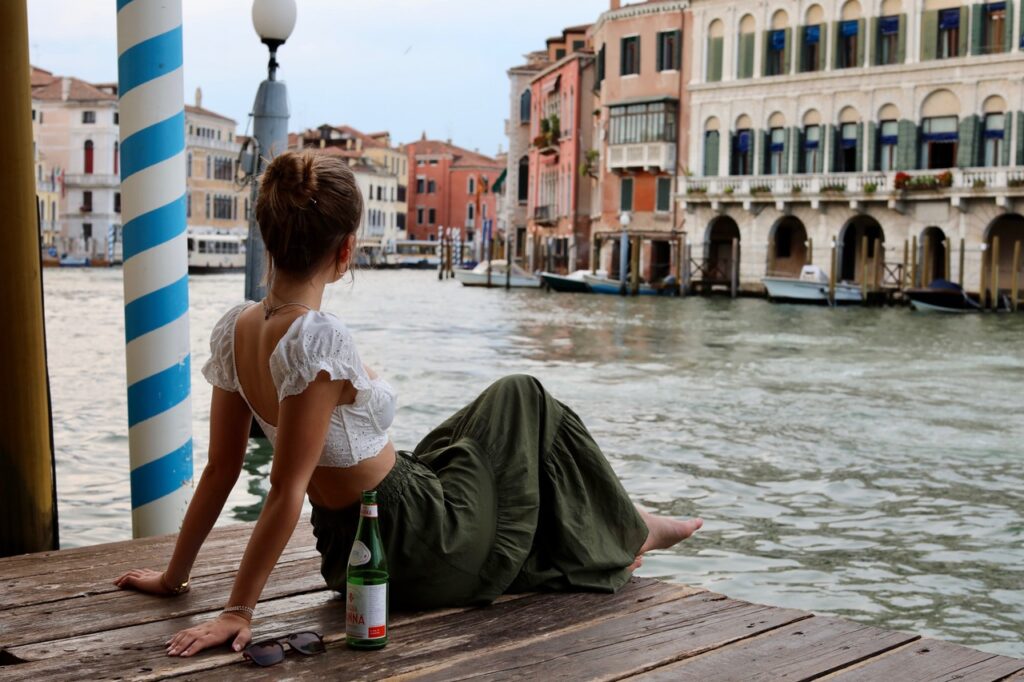
At the height of the Venetian Republic, the pali di casada, or “poles of the family,” colorfully marked the wealthy houses and establishments, especially for visitors at night. Historically topped with oil lamps, they now wear modern caps that sometimes mimic the shape of a flame.
During the early Renaissance, the Venetian nobility dressed their gondola, their gondolier, and their pali in their individual house colors. Until, that is, 1562 AD when the doge banned colorful gondola in order to curb the ostentation and competition of the ruling class. But the pomp of the pali remained, signaling the status, and sometimes even the politics, of the family name.
To the Venetian, the term casada refers not to the house or to the family, but rather to a person: a trusted servant, like a butler or gondolier. The one who tends to the family business, who asks no questions, whose loyalty is undisputed. Nowadays few if any Venetian families keep private gondolas, and none their gondoliers. But the pali survive, vestiges of the houses they served, still proudly wearing their colors for an indifferent world.
As the sun sets on my last night in Venice, I sit on the dock of the Palazzo Nani Bernardo, our temporary home. Its pali keep my company in their barbershop spiral of pale blue and white with blue flame atop. As I sit, I try to imagine what it might have been like at this palace at the height of its gilded glory: gas lamps burning in the sapphire night, and cloaked figures gliding silently toward masked rendezvous. But instead my mind turns over the lyrics from Cats’ Memory, and as it plays I contemplate how I’ll likely never see this city again.