“The Lord is close to the brokenhearted and saves those who are crushed in spirit.” Psalm 34:18
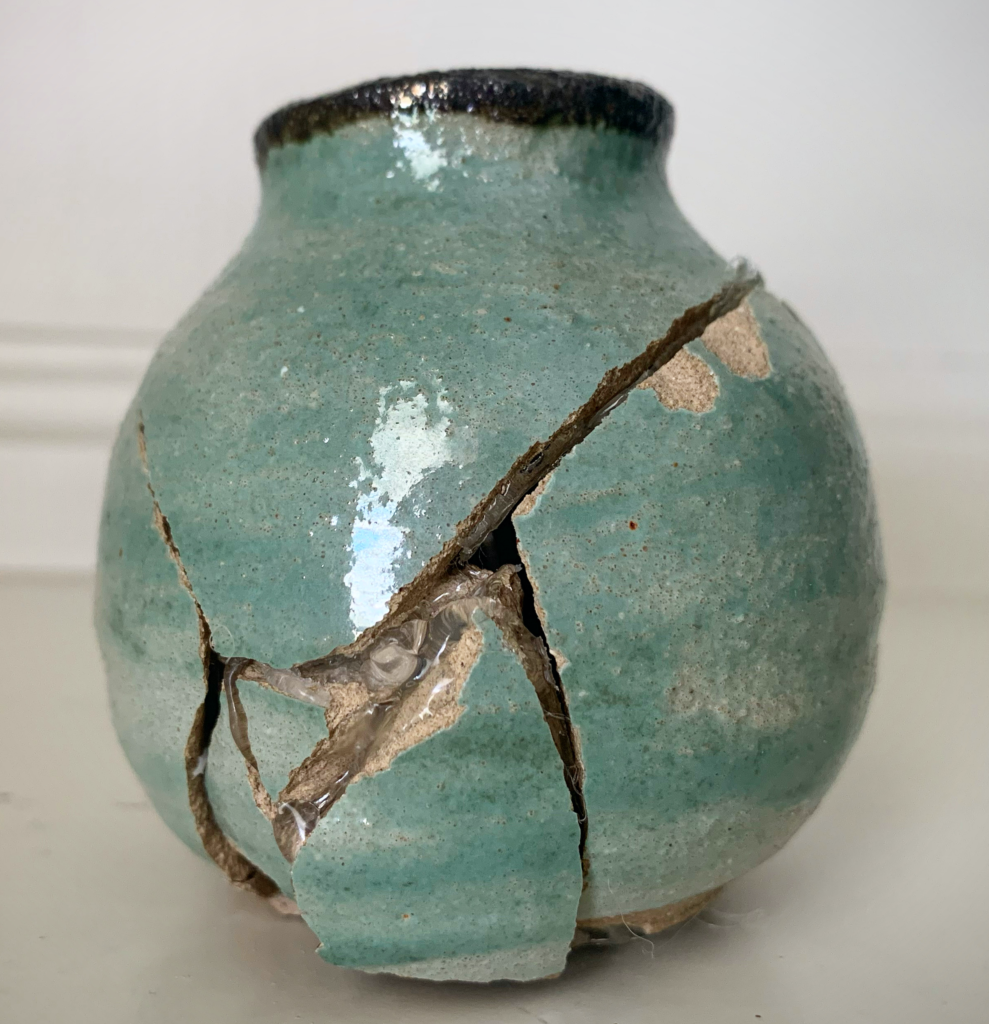
Years ago Riverbend hosted an art show displaying pieces made by homeless artists in a rehabilitation program. I fell in love with one of the small ceramic pots. It had a blue-green glaze washed over its grainy surface. It was beautiful and it gave me joy, so I bought it and put it on my shelf.
One day my children accidentally knocked it down, shattering it into pieces. Knowing how much I loved it, they gathered the shards and tried to glue it back together. They brought me the bad news and the patched-up vase at the same time, along with heartfelt apologies.
It was not as good as new, not anywhere close. Thick globs of glue held its geometric pieces roughly in place. Its many breaks appeared from every angle as deep gaps. My children stared at me with upturned faces, studying my expression for a sign. I smiled.
Before its break, my vase told me a single beautiful story of rehabilitation and hope, that of the woman who made it. But after the break, it told me two. It told me of the time my children filled my house with play and laughter, and of the time their earnest little hearts tried to right a wrong and keep me from feeling sad. My tiny ceramic vase was more valuable to me than ever before.
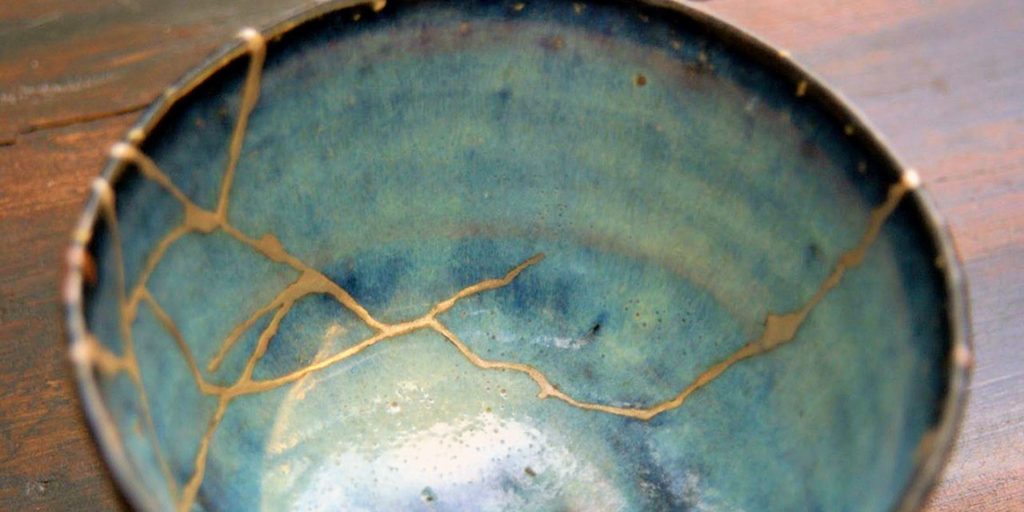
When my kids chose to fix my vase instead of throw it away, they were unknowingly following the centuries-old Japanese tradition of kintsugi. Kintsugi, meaning “golden repair,” is the Japanese art of mending broken pottery. Rather than try to disguise the breaks, kintsugi accentuates them, using gold or silver lacquer to highlight the veins of repair. In kintsugi brokenness is celebrated; the unique lines of breakage make the piece more beautiful, more rare, and more storied than before.
Kintsugi incorporates three Japanese philosophies: that of wabi-sabi, which embraces the flawed and imperfect, that of mottainai, which regrets waste, and that of mushin, which accepts change. Kintsugi finds value and beauty in the object’s history of use and wear. Rather than signal the end, a break indicates a good story and signals a new beginning.
When our worlds unexpectedly shatter, all is not lost. We can bring the broken pieces to our God who, like a kintsugi craftsman, delights to bring unique beauty to each fault line. Where we may see irreparable damage, He sees an opportunity. Our many fragments don’t deter Him. Rather He lovingly and patiently gathers, fits and smooths us into vessels of greater worth than ever before. And in His hands, the very lines along which we fractured—those edges dark and deep—become our strongest and most lovely features, seams of light paved with gold.
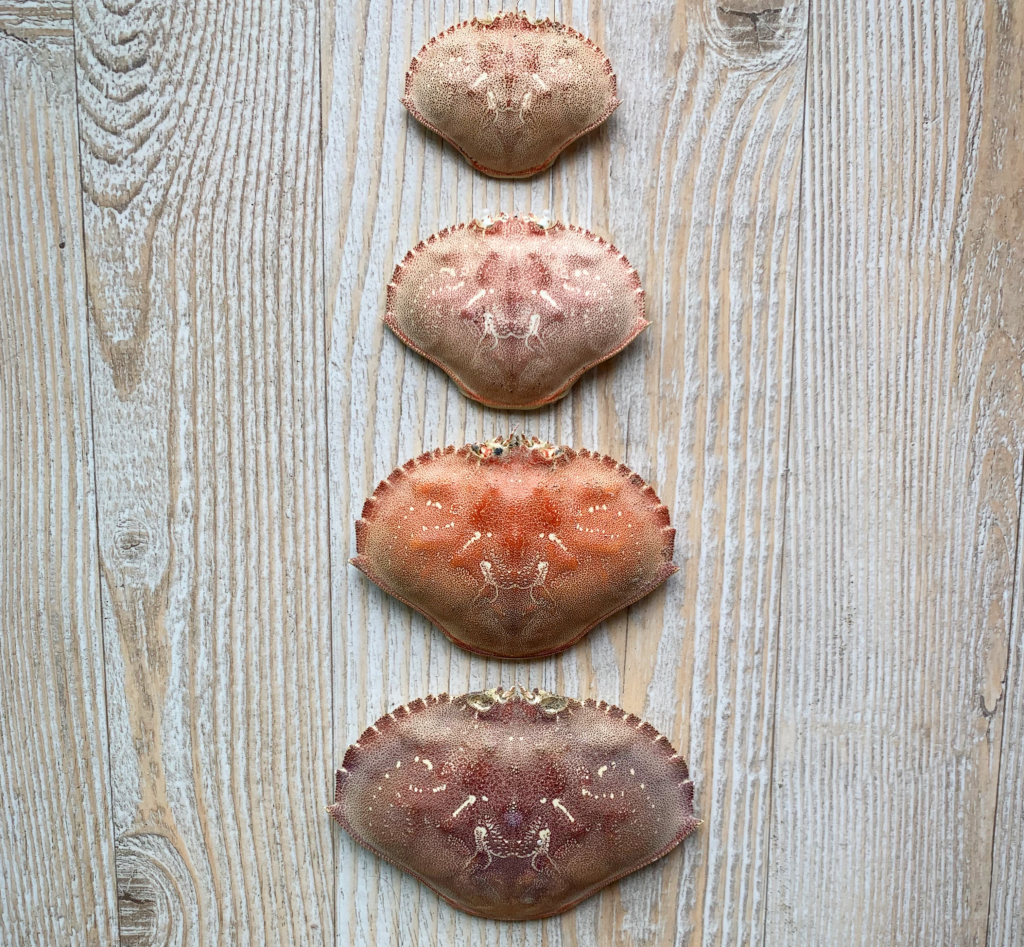
Crab shells collected at Nye Beach, Oregon, July 2020
Ten days ago, my family and I drove to the Oregon coast to escape the Texas heat and the monotony of home. I was starting to feel a bit trapped.
The beach here is not like the beaches in Texas. The Pacific water is ice cold, and a bone-chilling wind whips at your hair and coat. It is violent and loud. Each day with the tide the sand is littered anew with strange, oceanic finds: driftwood, seaweed, seashells and shellfish, and here and there, whole crab shells.
The first one I found took my breath away with its perfect symmetry and intricate design. Its reddish orange hue faded to brown at its crimped edge. It was beautiful, fragile and thin in my hand. I loved it and immediately started looking for others, an activity my kids were quick to catch onto. It didn’t take long for Ellie to ask the obvious question: “where’s the rest of it?”
Crabs, I’ve since learned, undergo a molting process that is essential for growth. About once a year, a crab will shed its shell by casting it off. First, they grow a soft shell underneath, then they swell with water to break the outer shell, eventually backing out of it and leaving it behind. For a few days, the crab will be particularly vulnerable as its new shell hardens. But in this period the crab rids itself of parasites and grows stronger, even growing back missing limbs. Then, in a year’s time when its new shell starts to prevent its growth, it will be time to molt again.
This reminds me of a word I learned recently and loved: liminal. It comes from the Latin word limen for “threshold,” and it means “relating to a transitional or initial stage of a process; occupying a position at, or on both sides of, a boundary or threshold.” Anthropologically, liminality refers to people being in the ambiguous, disorienting middle part of a rite of passage, or societies in the midst of political or cultural change. Liminal times are marked by uncertainty and doubt, but they also offer opportunities for great transformation and unprecedented change.
God used liminal periods throughout the Bible to grow His people. For example, forty years passed from the time Moses fled Egypt to when God called him to return as Israel’s leader. In that desert time, he learned to shepherd. Fifteen or more years passed from the time David was anointed as Saul’s successor to when he was actually crowned king at the age of thirty. In that time, he hid for his life, but also learned to lead men and to trust God. Similarly, the Israelites spent forty years wandering the wilderness, having passed out of Egypt but not yet entering the Promised Land. In that time of hardship, they dealt with sin. We also see similar liminal periods in the lives of Jacob, Joseph, and many others–times when God used a particularly uncomfortable, disruptive, and vulnerable time for necessary growth and development.
Sometimes called “the crossing over space,” liminal times are seasons of waiting. While frightening or frustrating on their face, these are times believers can trust that God is at work. Richard Rohr, Franciscan friar and author, wrote that the liminal space is where we are most teachable, and described it as:
“where we are betwixt and between the familiar and the completely unknown. There alone is our old world left behind, while we are not yet sure of the new existence. That’s a good space where genuine newness can begin. Get there often and stay as long as you can by whatever means possible. It’s the realm where God can best get at us because our false certitudes are finally out of the way. This is the sacred space where the old world is able to fall apart, and a bigger world is revealed. If we don’t encounter liminal space in our lives, we start idealizing normalcy.”
Idealizing normalcy. That sounds familiar. No doubt 2020 is a liminal space.
But now I think of the Dungeness crab whose shell I hold in my hand. I can picture it now: the icy cold water rushing into her home, bursting it open at the seams, forcing her to crawl backward out of its confined spaces. She is deliberately pushed out and made vulnerable by the very same Creator who fashioned the one-of-a-kind pattern on her back. And what feels like certain death is really just a requisite for growth, as she leaves all she’s known for the space between.
I’ve heard this—and said this—a lot lately. I’m terrible at waiting, and I don’t think I’m alone. We live in the “I want what I want when I want it” era, and expect instant gratification. I like swift results for my effort, whether that’s learning a new stay-and-shelter hobby or losing my newfound quarantine pounds. When time is our most precious commodity, isn’t faster always better?
I suspect past generations were better at waiting, largely because they didn’t have much choice. New clothing started with a needle and thread. Fresh bread meant grinding wheat into flour, shaping and leavening dough, baking. If you wanted fruits or vegetables, you planted a seed. Even just twenty years ago, watching a movie required a trip to Blockbuster. Now we can get all of the above delivered and streamed in under an hour.
What sounds like inefficiency now was in fact the design of a deliberate God who isn’t “slow to fulfill his promise as some count slowness” (2 Peter 3:9). Throughout the Bible, His revelation unfolds methodically. We see this in his oversight of the Israelites:
“I will not drive [your enemies] out ahead of you in a single year; otherwise, the land would become desolate, and wild animals would multiply against you. I will drive them out little by little ahead of you until you have become numerous and take possession of the land.” Exodus 23:29-30
I presume the Israelites would have preferred wiping out their enemies in a single blow, but God played the long game, just as he continues to do with us. It is a lesson in faith. We learn patience and what it means to surrender as we put in the work and leave the results to God. Our character develops in the waiting. Though we may feel as though we’re treading water, sowing but not reaping, we enjoy the knowledge that:
“Since ancient times no one has heard, no ear has perceived, no eye has seen any God besides you, who acts on behalf of those who wait for him.” Isaiah 64:4
God works for us while we wait. He knows the end from the beginning and slows the pace between, taking time to develop our character, readiness, and our relationship with Him. My dear friend and fellow Riverbender, Audrey Parker, once said: “Root-building doesn’t look like much above ground.” She’s right, it looks like nothing; it looks like waiting.
I was a fledgling prosecutor when a colleague, Brandy Bailey, handed me a tattered book titled Terrify No More. The cover showed the unsettling image of a frightened little girl being carried in a man’s arms. The book was written by the founder of International Justice Mission, a global anti-slavery, anti-trafficking organizationwith whom Brandy had spent the past year kicking down doors and rescuing the victimized.
I never made it past the cover; after a few days, I returned the book unread. It felt too dark and too big an evil for me. But nevertheless with that exchange, God began a work in my heart. Months later, when Brandy asked me to take a child abuse case to trial with her, I said yes, and my career as a child abuse prosecutor began.
In those days, I heard a story:
One day a man was walking along the beach when he noticed a boy picking something up and gently throwing it into the ocean. Approaching the boy, he asked, “What are you doing?” The youth replied, “Throwing starfish back into the ocean. The surf is up and the tide is going out. If I don’t throw them back, they’ll die.” “Son,” the man said, “don’t you realize there are miles and miles of beach and hundreds of starfish? You can’t make a difference!” After listening politely, the boy bent down, picked up another starfish, and threw it back into the surf. Then, smiling at the man, he said, “I made a difference for that one.”
I’ve been the old man and I’ve been the boy. It is easy to be overwhelmed by the extent of suffering, to choose not to act on a problem we can’t solve. But wonderfully, our God doesn’t ask us to fix the whole world. In fact, He reassures us time and time again that He’s got it all—heaven and earth and everything in them, the darkness and even the grave—conquered and accounted for. What He does ask of us is to love. To love others with a radical, selfless, moved-to-action kind of love.
“This is how we know what love is: Jesus Christ laid down his life for us. And we ought to lay down our lives for our brothers and sisters. If anyone has material possessions and sees a brother or sister in need but has no pity on them, how can the love of God be in that person? Dear children, let us not love with words or speech but with actions and in truth.” (1 John 3:16-18).
As we face this global crisis it is tempting to focus only on our own needs, or to let the enormity of the problem immobilize us. But Jesus says that when we act, when we serve, and when we love, we do it for Him—even when it’s only for the least among us, even when it’s only for one.
Please find below my writing for this week’s women’s ministry newsletter at Riverbend Church, dated Monday April 13.
This past week we learned that Austin’s shelter-in-place order was extended by another month, and I felt like my lifeboat sprung a new leak. My thoughts scrambled—scooping water, passing buckets—trying to figure out how to keep this thing afloat.
I was reminded of a military endurance test my dad once described, in which instructors took trainees out for a one-mile run. Near the end of that first mile the leaders would demand “one more mile.” Toward the end of that second mile, they would call for one more. On and on this would go for ten miles, twelve miles, the recruits believing each was their last. Not knowing the total distance at the start, even the long-distance runners in the group would quit early on, unable to handle the mental strain of this moving target.
Then there was Florence Chadwick, a woman who in 1952 attempted to swim the twenty-six mile channel between San Diego and Catalina Island. Fifteen hours in, a thick fog fell over the bay. Unable to see the shore and with doubt creeping into her mind, she swam one more hour before finally giving up and climbing into her rescue boat. It was only then she learned she’d quit just one mile short of the shoreline.
Perspective is everything. Proverbs 13:12 says “hope deferred makes the heart sick, but desire fulfilled is a tree of life.” It’s hard to love manna if our minds are set on the flavors of Egypt, and it’s hard to feel courageous when we’re more focused on the size of our enemies than on the size of our God. But the Bible encourages us:
“Let us run with endurance the race that lies before us, keeping our eyes on Jesus, the source and perfecter of our faith, who for the joy that lay before Him endured a cross.” (Hebrews 12:1-2).
And again: “We rejoice in the hope of the glory of God. And not only that, but we also rejoice in our afflictions, because we know that affliction produces endurance, endurance produces proven character, and proven character produces hope. This hope will not disappoint us…” (Romans 5:2-5).
The next time the military instructors announced a “one mile run,” the troops settled in for a marathon. And on her second attempt, even when the same dense fog set in, Florence Chadwick succeeded, reporting that she kept a vision of the shoreline in her mind the whole way. As for us, Jesus provides the only true perspective, the Hope that doesn’t disappoint, reminding us that it really isn’t about changing our circumstances, but about changing our hearts—be it one day, or one month, at a time.
Please find below my writing for this week’swomen’s ministrynewsletter at Riverbend Church, dated Monday April 6.
Growing up, my family had what we called “God’s box,” an ordinary shoebox with a slot cut into the lid. We would write down our prayer lists, pray over them, and drop them through the slot and into God’s hands.
The practice began before I was born. One of my favorite notes is my Dad’s prayer for “new baby,” written in his characteristic chicken scratch and dated eight months before I showed up. And it continues to this day, sitting on the upper shelf of my Dad’s closet next to many bags full of past prayers. It is a testimony: a living family record of our relationship with God, and of His faithfulness.
I loved our God’s box. As a little girl, it showed me my parents’ commitment to prayer, and taught me how to pray. Our family bonded over it, my brother and I taking a literal lesson in how to identify and share our burdens. But it also grew my faith. Whenever I would open the box and rifle through its contents, I found old worries on the scraps of paper—all pressing, all seemingly insurmountable when written—that I had simply forgotten once God took over. They spoke to me of how big God was, and how swift and real His answers.
But the biggest lesson of God’s box was how to let go. My Dad always said, “When you put a thing into God’s box, you give it to God. So if you want to worry about it again, you have to take it back out, out of His hands.” Although sometimes I considered it, I never did get the courage to fish any of my prayers back out. I just wasn’t willing to tell God that He should stop working on it, or that I could do a better job by worrying.
The Bible says, “Don’t worry about anything, but in everything, through prayer and petition with thanksgiving, let your requests be made known to God. And the peace of God, which surpasses every thought, will guard your hearts and minds in Christ Jesus.” (Phil 4:5-7).
I realized this past week that I needed a God’s box now; I needed to practice all over again how to leave my worries with Him. So yesterday as we sheltered in place, my family crafted our own. Embellished by the exuberant decorating of my 7- and 11-year olds, ours looks a little different than my Dad’s no-nonsense box, but the spirit remains the same.
I know we will drop into it requests that feel urgent and overwhelming. But I also know that God is bigger than anything we could write down. He will listen attentively and will begin working at once, taking our scribbled out notes into His loving hands. And He will work all things out for our good, even as I continue to learn, alongside my children, what it means to surrender, and to trust.
Please find below my writing for this week’swomen’s ministrynewsletter at Riverbend Church, from Monday March 30.
This past week, houses in our community brightened daily quarantine walks by placing stuffed bears in their windows so that families could “go on a bear hunt.” The idea began elsewhere but was quickly circulated on social media and eagerly adopted in my neighborhood.
It’s easy to see why. Like so many other parents sheltering in place, I am tasked with infusing my children’s days with structure and purpose, and giving them outlets to create, exercise, and “socialize.” I am suddenly the all-day tutor, counselor, and Sunday School leader—mom, in the truest sense—while simultaneously feeling like a little girl who desperately wants her own mom nearby to reassure her during this time of uncertainty. I’ve quickly discovered that the thirty-minute daily task labeled “walk the dog, aka go on a bear hunt” does as much for my own soul as it does for that of my kids.
On Monday’s walk, my family spied one large bear propped behind a window along our route, and we considered our “bear hunt” a total success. But by the end of the week, the count on our loop was up to ten bears: each one a different size or shape, nestled into windows here and there, uniting one house to another in this whimsical activity for kids. And every day for at least part of our journey, my fierce tribe of five couldn’t help but sing out the familiar lines from Michael Rosen’s beloved We’re Going On A Bear Hunt: “We’re going on a bear hunt, we’re gonna catch a big one. What a beautiful day! We’re not scared…”
I’ve been struck by how much this simple little tale speaks to the world right now. In the book, the family sets out on their adventure only to encounter a series of obstacles: tall grass, a cold river, mud, forest, snowstorm, and cave. Each time, they declare: “We can’t go over it, we can’t go under it. Oh no! We’ve got to go through it!” In the same way, we cannot “go over” or “go under” sheltering-in-place; we simply have to go through it. By its very nature, it will take time and be uncomfortable.
In life we are guaranteed unavoidable trials, but Jesus promises:
“I have told you these things so that in Me you may have peace. You will have suffering in this world. Be courageous! I have conquered the world” (John 16:33).
In other words, the toughest Dad of them all—Savior, Creator, and Friend—is going with us through whatever challenge we face along the way.
All week as my kids spotted bears in windows, I was counting the astonishing number of people—my neighbors—whose big hearts led them to add a little light as my family made our way through these dark times. In each participating window, I spied Jesus conquering the world.
I teach and write for the women’s ministry at Riverbend Church in Austin, Texas. Ordinarily I write a small piece for the newsletter every six weeks, but inthis uncertain time of Coronavirus I’ve been asked to write weekly. I have decided to share that here with you. Please find below my writing for this week’snewsletter, from Monday March 23.
Ten days ago the first whispers of “social distancing” reached my family. With three kids just released for spring break, I imagined an extended vacation of pajamas, cartoons and board games. My husband did our grocery shopping, and we laughed when he returned with pop tarts and potato chips instead of rice or beans. We had no sense of what we were truly facing.
It took only 24 hours for any humor to give way to worry. As grocery shelves emptied, hoarding lines formed, and medical supplies ran low, it felt as though the curtain had been pulled back to reveal a fragile society and an unstable future. I felt a great weight settle heavily on my heart for the health care workers, the unemployed and the small businesses, for the elderly and the sick, for the grocery store employees and truck drivers, for the immunocompromised—all those inevitably more affected by this new reality.
In ordinary times, I am blessed to find relief in fellowship with you. Our community at Riverbend is warm and inviting, and your smiles and hugs always make me feel better. But what about when worry hits in this time of isolation and quarantine, and I can’t run to my church to unburden?
King David seemed to wonder the same thing—and to find his answer—when he wrote this psalm of encouragement:
“I lift up my eyes to the hills—where does my help come from? My help comes from the Lord, the Maker of heaven and earth. He will not let your foot slip—He who watches over you will not slumber; indeed, he who watches over Israel will neither slumber nor sleep. The Lord watches over you — the Lord is your shade at your right hand; the sun will not harm you by day, nor the moon by night. The Lord will keep you from all harm—he will watch over your life; the Lord will watch over your coming and going both now and forever.” Psalm 121.
I took my kids for a walk yesterday and my 7-year-old daughter explained “social distancing” to my 3-year-old son this way: “We have to stay six feet apart from all other people. Which is how tall Daddy is. So, we have to stay one Daddy away.”
Never before have I heard “Daddy” used as a unit of measurement, but how fitting. We are always one Daddy, one Heavenly Father away. We are one Daddy away from hope, from provision, from healing, from peace, and from each other. We are connected in spirit to one another and to Him, our good, good Father.
Romans 8:15-18 says:
“For you did not receive a spirit of slavery to fall back into fear, but you received the Spirit of adoption, by whom we cry out, ‘Abba, Father!’ The Spirit Himself testifies together with our spirit that we are God’s children, and if children, also heirs—heirs of God and coheirs with Christ—seeing that we suffer with Him so that we may also be gloried with Him. For I consider that the sufferings of this present time are not worth comparing with the glory that is going to be revealed to us.”
I’m praying for each one of us that we remember to look to our Father for our help and our belonging. Until next week, I’m only one Daddy away.
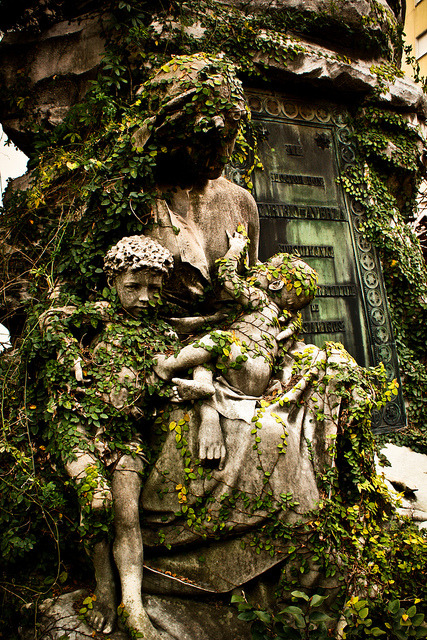
Cementerio de la Recoleta, Buenos Aires, Argentina
The Bible tells us a story about two very different twin brothers. The firstborn Esau came out of the womb with the younger Jacob grasping at his heels. Esau became an expert hunter and outdoorsman, while Jacob liked to stay home. One day, Esau returned famished from a hunt and asked his brother for some food. Jacob replied that he would feed Esau if Esau gave him his birthright in exchange. And just like that, for some bread and a bowl of lentil soup, Esau gave up his inheritance.
My whole life, I’ve scratched my head at this. Why would anyone sell their birthright for a bowl of soup?
It was Jacob whom God renamed Israel and whose twelve sons became the tribes of the promise. And it was his descendants, some five hundred years later, whom God led to the promised land, commanding that they drive out all its inhabitants, and that they destroy all the local idols and high places.
The high places were pagan centers of worship. Widespread throughout Canaan, these idolatrous shrines housed graven images, altars, incense stands, and sacred pillars, and often, too, their own priests and abominable rites like prostitution and child sacrifice. Desiring a people set apart and wholly His, God warned the Israelites that any high place they allowed to remain would become a thorn in their side and would turn their hearts away from Him. Nevertheless, Israel did not completely destroy Canaan’s high places.
It did not start out as outright rebellion, but as an oversight. Israel looked the other way because they were tired and comfortable. The high places were convenient. Before the temple was built, the high places served perfectly well as a place to worship the Lord their God. But over time, their failure to follow through— to fully obey— opened them up to casual sin, and ultimately to total corruption.
The Bible records how each of Israel’s and Judah’s kings dealt with the high places in their time. For forty monarchs spanning three hundred years, God kept a detailed account. While the history is nuanced, an overarching degradation is plain:
At first, God was still loyally worshipped, though the high places remained.
Then God was worshipped at the high places.
Then God, plus other gods, were worshipped at the high places.
And finally, only other gods were worshipped at the high places.
It was because of the sin of the high places that God ripped Israel away from Judah, splitting the kingdom in two. And it was because of the sin of the high places that both kingdoms were ultimately captured and exiled. God warned from the outset what it would cost them, but the Israelites didn’t listen. The Bible says, “They pursued worthless idols and became worthless themselves.” 2 Kings 17:15.
Do we have high places in our lives today, sin centers so culturally engrained that we turn a blind eye to them?
The truth is, it is easy to be casual about some sin. Especially when those choices are sanctioned by the world. We’re allowed to struggle with forgiveness; it’s natural to carry an offense around for at least a little while. We’re expected to lust after attractive people; after all, it isn’t adultery, and it’s youthful to have a healthy appetite. We’re expected to throw time away on our phones, to strive with irritable coworkers, and to complain about our boss. We’re expected to be more tuned in for a football game than for worship, and to survive parenthood by anesthetizing it with wine. We’re expected to share in gossip; silence would seem judgmental. And so, slowly but surely, sin about which God has been perfectly clear, gets from us a hall pass. One day at a time, we make easy choices to pursue the comfortable and the convenient, not realizing that these are the small altars on which we’ve offered up our lives.
To this, God prophesies: “I will give up your wealth and all your treasures as plunder because of the sin of your high places in all your borders. You will, on your own, relinquish your inheritance that I gave you.” (Jer 17:3-4)
You will, on your own, relinquish your inheritance.
Are we all that different from Esau? We have a birthright in Jesus that is ours to claim as sons and daughters of the King. But when our lives are over and we kneel before Him, will we find that we’d somehow left our inheritance beside the road in pursuit of that which feels, in hindsight, like not much more than a bowl of soup?
“For the turning away of the naive will kill them, and the complacency of fools will destroy them.” Proverbs 1:32
If the heritage of Esau is to be complacent– smug and self-satisfied– then what is the heritage of Jacob?
Jacob was a hustler, and his was a legacy God repeatedly rewarded. Rebekah, the chosen bride for the one true heir, earned her place by offering to give water not only to the servant of the Lord, but to his ten camels, too. Achsah, Caleb’s daughter, asked her father for not only land in the Negev as her wedding present, but the springs of water also. Ruth, a foreigner, clawed her way into the family of God by refusing to take ‘no’ for an answer. Elisha, despite being told to turn back three different times, refused to leave his mentor and so received Elijah’s mantle and a double portion of his spirit. And Jacob, having obtained the birthright, stolen his father’s blessing, and received God’s promise, still wrestled all night with God and refused to let Him go until he had received even more.
“Jacob have I loved, but Esau have I hated,” said God.
Both brothers were sinners. It wasn’t that. It was their heart.
The firstborn, Abraham’s grandson and heir of the promise, stood to receive everything God had to offer man. But he did not treasure what he had, and therefore grew to despise it. Having valued worthless things, he became worthless himself. But the younger, born minutes outside the family’s fortune, knew exactly its value. Unwilling to do without, he fought his way in and refused to let go, clinging to the promise in which his and his family’s future rested. And having tasted of a covenant that gave rain in its season and grain in its time, saw there a reminder to stay humble, and hungry.
Solitude, Thomas Alexander Harrison, 1893, oil on canvas
2019 was the year I studied Sabbath.
It began in January with Jen Wilkin’s Better, an in-depth dissection of Hebrews. Her book held me upside down and shook me like a snow globe, so that all my inner parts swirled and whirled about and still haven’t quite settled.
That led me to Priscilla Shirer’s power-packed study, Breathe: Making Room for Sabbath, and to Shauna Niequist’s Present Over Perfect. These, and others, fed me this past year like the ravens fed Elijah in the wilderness. They reached out through the pages and kept me company, offered their “grace and nourishment” (Shauna’s words), and taught me.
Sabbath, I learned, is so much more than a day off from work. It is a rhythm for life as old as creation, practiced by God Himself. It was God’s commandment for His people, an act of obedience, a prerequisite to blessing. He called it a gift and a celebration; and with it He delivered them from slavery to freedom. It is an Old Testament ritual embodied and fulfilled in the person of Jesus Christ.
Sabbath is also worship. It is a love note to the Lord: a symbol of commitment, a renewal of vows. It is a preventative against idolatry and excess, against focusing too much on works. It is a boundary line we erect around the praise-worthy and the sacred, one that keeps the good in and the bad out. It is a confession, both outwardly and inwardly, that God is All.
It gathers to the altar all the wayward parts of ourselves, binds them there and sets a fire. It requires discipline and intentionality, humility and faith. It is all at once release, return, and rest. As Jen Pollock Michel wrote in “A Story Called Rest”:
“…the world’s beginning introduces the scandalous idea of divine work for the purpose of human flourishing– a world in which true rest is possible because Someone Else is awake.”
True rest, because God is faithfully awake.
After a year’s study, I’ve distilled it down to this: Sabbath is God’s invitation to us to be kids again. To play, to ask for help, to trust. To feel fully cared for and carefree. To enjoy a soul-deep break from our burdens, letting our Father have all our weight so we can both finish the race and notice the beauty all around us as we go.
We won’t get very far with Sabbath if we don’t begin with the belief that He is a very good, trustworthy Father. We also won’t get very far with Sabbath if we think that what we do has any affect on His love for us. We don’t win over His affection with our accomplishments. And yet, as Shauna Niequist put it: we tend to do for Jesus, instead of being with Jesus.
To truly be with Jesus requires a slower pace. It is seeing and being fully seen. It is intimacy. It is hard.
As with every year’s end, I find myself looking back. I remember those people who hurt me, and those whom I’ve hurt. Each unmet expectation alongside the answered prayers. All the stuff I want to explain to Him, or have Him explain to me. But Sabbath is also the recognition that God is big enough for all the ships that won’t come in. All the closure, answers, and apologies, that lie scattered and lost at the bottom of the deep. He’s big enough to handle regret over our past and anxiety over our future so that we can be here– in this present moment right now– walking through the questions of our unfinished stories, with Jesus.
Putting Sabbath into practice is hard for me, but I’m learning. I’m trying to take time to just sit quietly at His feet without getting up to accomplish something. I’m trying to give my family all of me, not the me that’s also straightening up around the living room with one thought somewhere else. And I’m trying to take all the uncomfortable stuff that’s hard– the wrongs I want to right by forcing others to listen or change or understand– and to let Him have that, too. In all its mess. To tell Him where it hurts and why it sucks, and to let Him be the Dad so I can get back to being the kid. So I can have a life of outrageous dreams, wild laughter, honest relationships, and deep, restorative sleep.
I have a playlist of my favorite holiday music and one of my most loved songs is Casting Crowns’ I Heard the Bells on Christmas Day. It says: “Then rang the bells more loud and deep, God is not dead nor does He sleep. The wrong shall fail the right prevail, with peace on earth, goodwill to men.”
Peace on earth. Goodwill to men. THAT is the heart of God. That is the essence of Sabbath. I pray it’s not just my 2019, but my 2020, too. And not just mine, but yours.