Sixty-five miles outside of Florence was a world away.
When we lifted our paddle at a gala auction last fall, “seven nights in a Tuscan villa” was all we knew. Setting out to find exactly where and what we bought was exciting.
Halfway between Arezzo and Cortona down the final stretch of country roads, our GPS took us up a private “neighbors only” drive. This brought the locals into the street in a dusty huff to let us know our error, their fingers pursed and shaking at the heavens in a flurry of Italian expletives. But leaving them behind for a right turn and then a left, we found our place tucked cozily out of view behind an iron gate and a hedge of oleander trees in pink bloom.
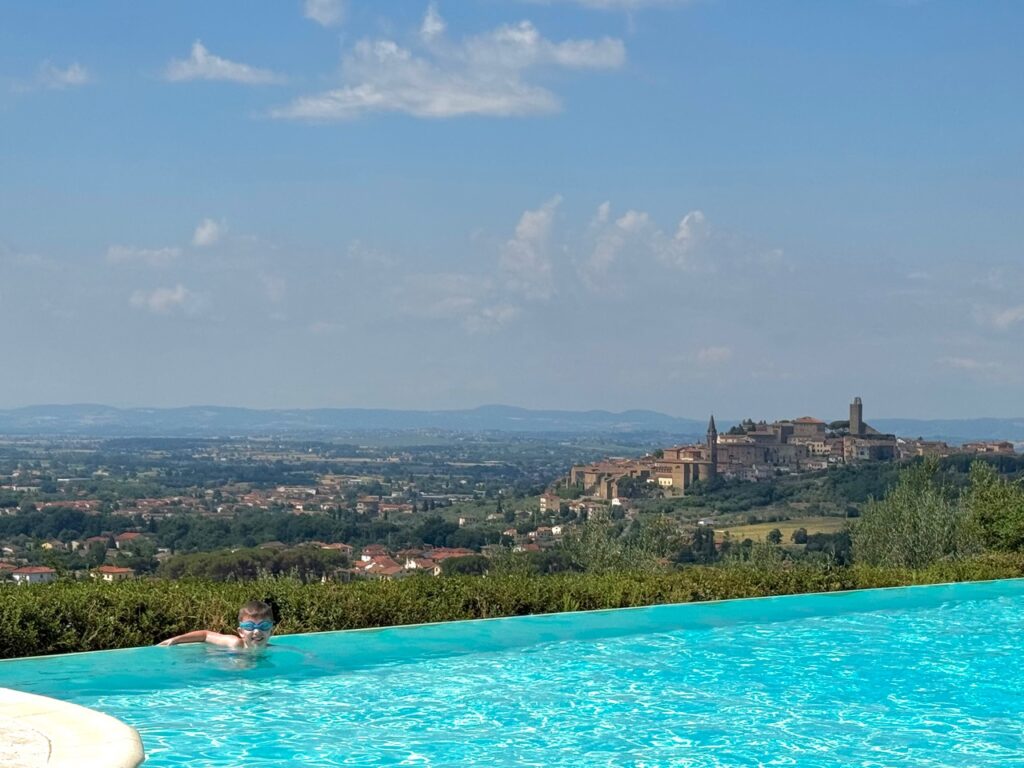
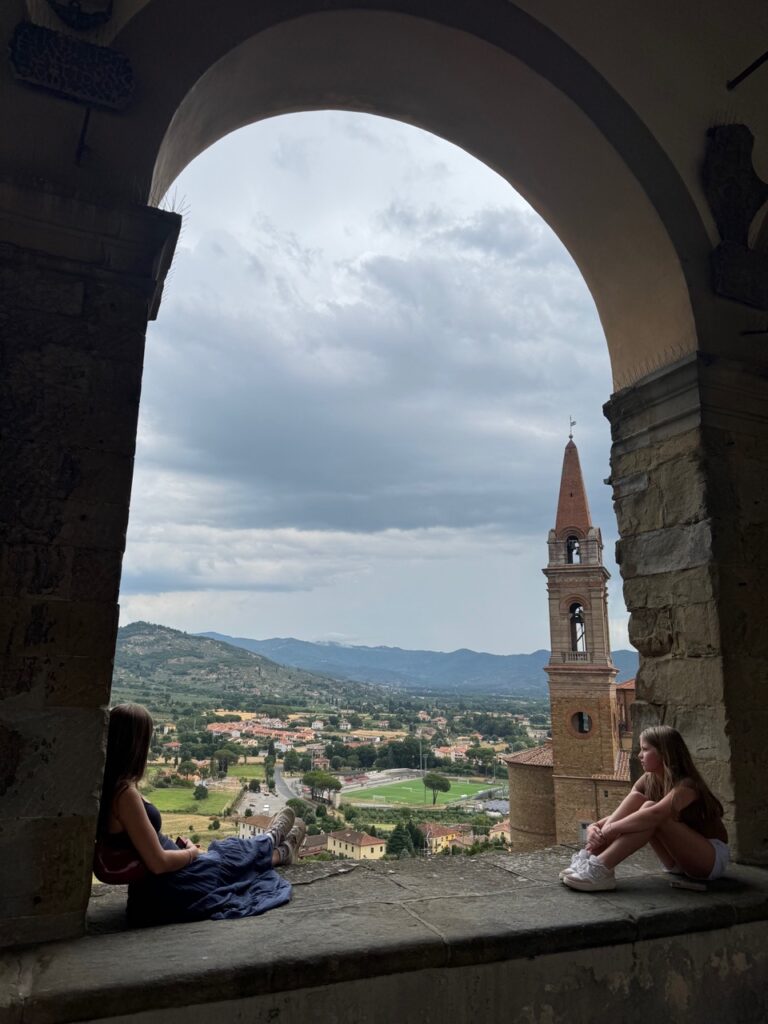
The villa was charming and remote, a modernized storybook: the creamy stones and gnarled wood of a medieval farmhouse, elevated by a sleek infinity pool overlooking the countryside. A cypress tree framed the view of the valley and the surrounding hills—a patchwork of olive groves and vineyards dotted with homesteads. Stacked on the adjacent hilltop just over a mile away, the fortified town of Castiglion Fiorentino kept lazy guard as it had done for millennia, its bell towers reaching for the sky.
With arms folded over the edge of our pool, I’d trace the lines of its medieval walls and imagine the dozens of different flags flown over its battlement through the centuries: Arezzo, Perugia, Siena, Florence. I’d squint through the summer haze and try to picture what she might have looked like under feudal siege, a sea of glinting armor restless at her gates.
Then I’d try to go even further back, to the Etruscan settlement whose 4th century BC walls and temple lie buried in rubble beneath her ramparts. What was it like to work and worship on that hill then? Rome was rising, Persia was falling, and a thousand or more miles away Nehemiah was rebuilding his own temple and walls with similar stones. But my thoughts were interrupted.
Because every afternoon a glorious thing would happen at our pool.
For fifteen to twenty minutes once or twice a day, evaporation would trigger our pool’s auto-fill system, and a cascade of water would shoot into the pool out the mouth of a rock fountain at the far corner. The first day, in sheer surprise and delight the kids and I swam to the waterfall, squealing and splashing each other in fun. But within minutes they moved on, the jet of brisk water too forceful for play.
But not me.
I stood there mesmerized, chin dropped and head back, letting it assault my neck and shoulders. The power of it shocked me into wonder and submission; I couldn’t quite believe how fantastic it was. At one point I genuinely considered that God, out of His infinite love, had sent me angels disguised as hydromassage to pound on my back.
I felt sheer joy at such profound goodness. The way the roar of the water drowned out the otherwise pervasive and raucous trill of cicadas. The lavish luxury of an icy cold torrent of water—so decadent in its barrage!—in a country that doesn’t do ice or A/C like we do, a land of inescapable heat. So I stood there with tears in my eyes and laughter in my throat, stunned by the beauty and the perfection of the moment.
And then it stopped.
The pool was once again still. The day hot. The bugs noisy. And it was over.
So each day when the fountain would come on, I’d get there as fast as I could. I’d stand beneath it with eyes shut tight, soaking in every minute of its unpredictable gift.
One day, Mitch woke me from a nap shouting, “Mom, it’s on! It’s on!” And to my family’s amazement I wasn’t mad, I was grateful. I sprinted to the yard discarding my clothes along the way, and hit the water with such a fervor you’d think it was the Pool of Bethesda and I in desperate need of healing.
Tuscany taught me a valuable lesson: some things are extra special because they can’t be forced. And they can’t be faked. And they can’t be enjoyed forever. All you can do is savor it, thank the Giver, and then let it go.
I learned this from the in-home chef who taught us how to make pasta from scratch. I learned this from the vintner at the local winery, who spoke to us about fermenting grapes and pressing olive oil. I learned this from the salumiere in San Gimignano who took his sweet time preparing our lunch, spending as long to shave the meat as it took to cure it. And I learned this from my fountain.
In the end, our time in Tuscany was this way. Somehow even though each day only crawled by—the minutes wholly unhurried—seven nights still managed to pass in a blink. Despite all the time we had there, we somehow felt that we’d left so much still undone.
But as we drove away, and the stone walls of Castiglion Fiorentino slipped out of view behind the earth, I realized just how fitting that was.